
The Family and Medical Leave Act (FMLA) allows you to take up to 12 weeks off work within 12 months to deal with qualifying medical conditions. Not everyone knows this, but you can use the FMLA for mental health reasons. In fact, it can be vital for people overcoming addiction.
Find out more about the FMLA and how you can use it to overcome your dependency issues.
What is the FMLA?
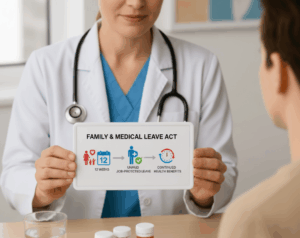
The FMLA is a U.S. federal labor law that allows employees to take job-protected, unpaid leave for specified family and medical reasons. The push to pass the policy began in the 1980s, as more women entered the workforce. With both parents working, there was a greater need for one parent to take time off to handle domestic duties.
During that time, an early version of the bill, the Family Employment Security Act (FESA), was proposed, calling for up to 26 weeks of job-protected leave for reasons like a new child, a child’s illness, a spouse’s disability, or the employee’s own disability. Over the next several years, similar bills were proposed. However, there were concerns regarding the balance of employer and family interest.
The FMLA finally came together in 1984 and was introduced every year. However, it was vetoed twice by George H.W. Bush, who supported family leave but preferred a voluntary approach for employers.
When Bill Clinton became president in 1992, he prioritized the bill and passed a revised version. It became a law on August 5, 1993.
What Does the FMLA Cover?
The FMLA covers the following situations:
- Recovery from childbirth
- Leave for adoption or foster care placement of a child
- Inpatient care, including overnight hospital stays
- A period of incapacity lasting more than three calendar days requiring doctor’s visits at least twice a year
- Continuing treatment for a chronic condition requiring at least two doctor visits a year
- Leave to care for a family member with a serious illness
- Up to 26 weeks of unpaid leave within 12 months to care for a covered service member with a serious illness or injury
- Leave for qualifying exigencies related to a family member’s active duty or call to active duty
Do You Get Paid Under the FMLA?
The FMLA guarantees up to 12 weeks of unpaid leave and up to 26 weeks of unpaid leave for military-related medical leave, as well as job protection and continuation of your group health insurance plan. However, it does not require your employer to pay you while you are out.
You may receive pay during FMLA leave if:
- You apply accrued time off (sick leave, vacation, PTO) to your FMLA leave
- Your employer offers paid leave benefits
- You live in a state that offers a paid family/medical leave program, or you qualify for short-term disability insurance
Are All Employees Required to Follow the FMLA?
No, the FMLA only applies to:
- All public agencies
- All public and private elementary and secondary schools
- Private sector employees with 50 or more employees in 20 or more workweeks throughout the calendar year
What Mental Disorders are Covered Under the FMLA?
The FMLA does not list specific disorders. However, the bill pertains to any serious health condition that requires inpatient or ongoing care and impacts your ability to work. This may apply to:
- Major depressive disorder
- Severe anxiety disorders
- Bipolar disorder
- Post-traumatic stress disorder (PTSD)
- Obsessive-compulsive disorder (OCD)
- Schizophrenia and other psychotic disorders
- Dissociative disorder
- Eating disorders
- Substance abuse disorders when receiving inpatient care or structured treatment
FMLA for Recovery
Many people with substance abuse disorders are reluctant to go into recovery. They may present several arguments against it, but one very real concern is losing their job.
A 2020 CDC report reveals that employers who don’t offer flexibility in medical care leave present barriers to recovery and increase associated expenses. An individual may be concerned that taking off work for 30-90 days, the average length of a recovery program, will cause them to lose their employment, leading to various financial issues.
The FMLA allows people to take job-protected leave for up to 84 days. With weekends, that’s enough to cover a 90-day program. Individuals can take time off work to heal without losing their jobs.
How to Use FMLA for Addiction
FMLA can be used to cover various aspects of recovery treatment, as follows:
- Inpatient Programs: These typically last for 90 days and include initial detox and therapy.
- Intensive Outpatient Programs (IOP): Patients may spend up to 8 hours a day in therapy and go home to their families at night, leaving them little time to work.
- Outpatient Care: After patients undergo recovery, they typically continue outpatient care with therapy sessions once a week or as needed for flare-ups and rehab prevention. The FMLA can cover time off needed to attend these sessions.
How to Apply for FMLA Mental Health Leave
To apply for FMLA mental health leave, you must:
- Check your eligibility: You will be eligible if you work for an employer with at least 50 employees, if you have worked for your employer for at least 12 months, and have worked at least 1250 hours in the past year. Additionally, your condition must require inpatient or ongoing care.
- Notify your employer: Ideally, you should give your employer at least 30 days’ notice. However, if the leave is unexpected, notify them as soon as possible.
- Employer Response: Your employer must respond to your request within five business days and provide the necessary forms, including the medical certification form
- Get Medical Certification: Take the form to your medical provider. You will have at least 15 calendar days to return it.
- Submit the Forms: Return the completed forms to your employer, typically through your HR department.
How to Talk to Your Employer About FMLA for Addiction Treatment
People are often concerned about discussing their need for FMLA for recovery with their employers. However, there is no need to specify that you require FMLA for a dependency issue. Here’s an approach that may be more comfortable.
- Speak to HR First: HR will explain your rights and options so you can approach your employer without oversharing.
- Plan What You Will Say: Rather than mentioning an addiction, you can merely explain that you have a serious health condition and require prolonged treatment.
- Talk About Logistics, Not Details: Tell your employer how much time you will need to recover, your start and end dates, and whether leave will be continuous or intermittent. You should also discuss how your work will be handled while you’re away.
- Ask for Your Forms: Request your forms and turn them in via the process discussed above.
Remember that FMLA-related medical information must be kept confidential. So even if your employer discovers you need FMLA for addiction treatment, they cannot share that with anyone in the office.
The Benefits of FMLA on Mental Health and Addiction Treatment
Various studies reveal how the FMLA can improve mental health and related substance abuse issues, as follows:
- A 2025 NIH study reveals that workers with sick leave were 48% less likely to report feelings of depression, 27% less likely to report daily anxiety, and 51% less likely to report both anxiety and depression.
- A 2022 working paper found that family leave reduced the likelihood of depression and anxiety in women caring for a spouse or parent with a serious medical condition.
- A review of 45 studies showed that women with maternity leave experienced lower stress, fewer depressive symptoms, and a lower rate of hospitalization for mental health conditions.
BlueCrest Detox Works with FMLA Coverage
At BlueCrest, we understand the commitment required to check into a residential facility. We are here every step of the way.
Our team will help you transition from a workplace to a facility environment and back with minimal stress. We use a customized approach to make the adjustment easy. Our facility offers various treatment modalities to support long-term sobriety.
Contact us when you’re ready to make a change.
FAQs
Can I use FMLA for mental health?
Yes, you can use FMLA for a serious mental health condition or to care for a close relative with a serious mental health condition.
What counts as a serious mental health condition under FMLA?
For a mental health condition to be considered serious, it must require inpatient care or continuing treatment from a provider.
What mental health conditions commonly qualify?
Conditions like major depression, severe anxiety, bipolar disorders, eating disorders, dissociative disorders, and certain substance abuse disorders can qualify for the FMLA.
Can I use FMLA for therapy or counseling appointments?
Yes, if your condition qualifies, you can use FMLA for therapy, counseling, psychiatric visits, or other treatment appointments that may be eligible as intermittent needs or reduced-schedule appointments.
Can I use FMLA to care for a family member with a mental health condition?
Yes, you can use FMLA to care for a spouse, child, or parent with a mental health condition, including adult children who are unable to care for themselves due to a cognitive disability.