
Choosing a drug detox in New Jersey is choosing where the first, and often most medically sensitive, days of recovery happen. Withdrawal from some substances, particularly alcohol and benzodiazepines, can be medically serious, and opioid withdrawal is intensely uncomfortable, so the level of supervision, the medications available, and what happens the day detox ends all matter. Those details are usually several pages deep on a provider’s website.
Table of Contents
- How We Choose
- The 6 Best Drug Detox Centers in New Jersey for Personalized Care
- #1. BlueCrest Detox – Best for Private, Medically Supervised Detox in Hunterdon County
- #2. Guardian Recovery, Princeton Addiction Center (Formerly Princeton Detox & Recovery Center) – Best for Detox Connected to a Full Continuum of Care in Middlesex County
- #3. SOBA New Jersey – Best for Detox with Housing and Case Management in New Brunswick
- #4. Discovery Institute – Best for a Long-Established Provider with Detox and Residential Care in Marlboro
- #5. Recovery Centers of America at Raritan Bay – Best for Detox with Defined Detox Timeframe in South Amboy
- #6. Serenity at Summit – Best for Detox and Residential Care at One Site in Union
- Frequently Asked Questions
- Conclusion: Matching the Right Detox to Your Situation
This guide compares six New Jersey programs that describe medically supervised detox as part of their own services. We compare them on medical supervision, medication approach, what comes after detox, location, and how much verifiable information each one publishes. The list covers Hunterdon, Middlesex, Monmouth, and Union counties, so you can look at options close to home or within a manageable drive.
Our first pick is BlueCrest Detox in Flemington, a good fit for people who want a private, quiet setting for medically supervised detox in Hunterdon County, with a direct path into continued care through BlueCrest Recovery Center’s PHP, IOP, and outpatient programs. Below that, you will find a short methodology section, a comparison table, a profile of each program, and answers to common questions.
If you or someone you know is having a medical emergency, such as seizures, confusion, or trouble breathing during withdrawal, call 911. For emotional crisis support, call or text 988 to reach the 988 Suicide & Crisis Lifeline: https://988lifeline.org/.

How We Choose
Every program on this list was reviewed against five criteria that help families compare meaningful differences instead of marketing language. Details come from each provider’s own website and other publicly available information collected in October 2026. They describe what each program says about itself and have not been independently audited, so please confirm specifics directly before you admit.
Medical Detox Provided by the Program
We looked for programs that describe medically supervised detox as a service they provide themselves, not only as a referral to an outside facility. Programs that arrange detox through partners can still be a good choice, but they offer a different kind of service, so they aren’t on this list.
Medical Supervision and Medication Approach
We noted how each program describes round-the-clock monitoring, nursing and physician involvement, and the medications it uses to ease withdrawal or cravings. Where a program does not publish this, we say so, and we suggest asking about it directly.
Continuum of Care After Detox
Detox addresses physical dependence, but it is not treatment by itself. We looked at whether each program connects detox to residential care, partial hospitalization, intensive outpatient, dual-diagnosis treatment, or aftercare, so that the transition does not depend on a separate search.
Licensure and Accreditation
We looked for programs that state their licensing or accreditation clearly, for example a Joint Commission accreditation or a New Jersey Department of Health license. Where a program publishes this, we mention it as the provider’s own statement. Where it does not, we say so. You can look up state licensing through the New Jersey Department of Health at https://www.nj.gov/health/ and search for accredited organizations through the Joint Commission.
Transparency of Public Information
We considered how clearly each program publishes its levels of care, leadership and clinical staff, insurance information, and credentials. Programs that name their clinicians and state their licenses are easier to evaluate, and we flag where information is limited.
The 6 Best Drug Detox Centers in New Jersey for Personalized Care
With those criteria in mind, the following six programs are worth a closer look for drug detox in New Jersey. Each is listed with the need it serves best, not as a claim that one program is right for everyone.
| Provider | Best For | Key Strength | Location (NJ Region) |
|---|---|---|---|
| BlueCrest Detox | Private, medically supervised detox in a quiet setting | Private rooms, 24/7 medical support, and a direct path to ongoing care | Flemington (Hunterdon County, Northwest NJ) |
| Guardian Recovery, Princeton Detox & Recovery Center | Detox connected to a full continuum of care | Detox with residential and outpatient levels | Monmouth Junction (Middlesex County, Central NJ) |
| SOBA New Jersey | Detox with housing support | Detox with sober living options | New Brunswick (Middlesex County, Central NJ) |
| Discovery Institute | A long-established provider | Detox and residential care | Marlboro (Monmouth County, Central NJ) |
| Recovery Centers of America at Raritan Bay | Large-scale detox | Defined detox timeframe | South Amboy (Middlesex County, Central NJ) |
| Serenity at Summit | Detox through outpatient at one site | Detox and residential care at one location | Union (Union County, North/Central NJ) |
#1. BlueCrest Detox – Best for Private, Medically Supervised Detox in Hunterdon County
BlueCrest Detox describes itself as a private drug and alcohol detox facility and as part of BlueCrest Health Group. It is located at 6 Minneakoning Road in Flemington, in Hunterdon County. Care starts with an assessment that is used to build a personalized plan, followed by medically supervised detox in a private setting.
According to its website, licensed professionals are on hand around the clock, vital signs and overall health are closely monitored, and medications are given as needed to ease withdrawal symptoms. It names alcohol, opioids, and benzodiazepines among the substances it treats.
Clients stay in private rooms with full-size beds and personal TVs, with meals prepared by a private chef, and massage, acupuncture, yoga, and mindfulness are offered alongside medical care. After detox, the website describes moving into its partial care recovery counseling programs, and it lists medication management and aftercare. Its Team page names Dr. Aykut Ozden, MD, as a physician and James Martin Chitty, LCSW, CCS, as Vice President of Clinical Operations.
Strengths include:
- Private rooms and a discreet, confidential admissions process, with private pickup offered
- Round-the-clock medical support, plus 24/7 access to clinicians and psychiatric providers, according to its website
- Continuum of care, with a direct path from detox to dual-diagnosis treatment, medication management, and aftercare
- Holistic options such as massage, acupuncture, yoga, mindfulness, art therapy, and nutritional counseling
Trade-offs:
- Detox length and specific medications are not published, so ask about them during intake
Best for: People seeking long-term recovery who value a proven, evidence-based treatment approach.
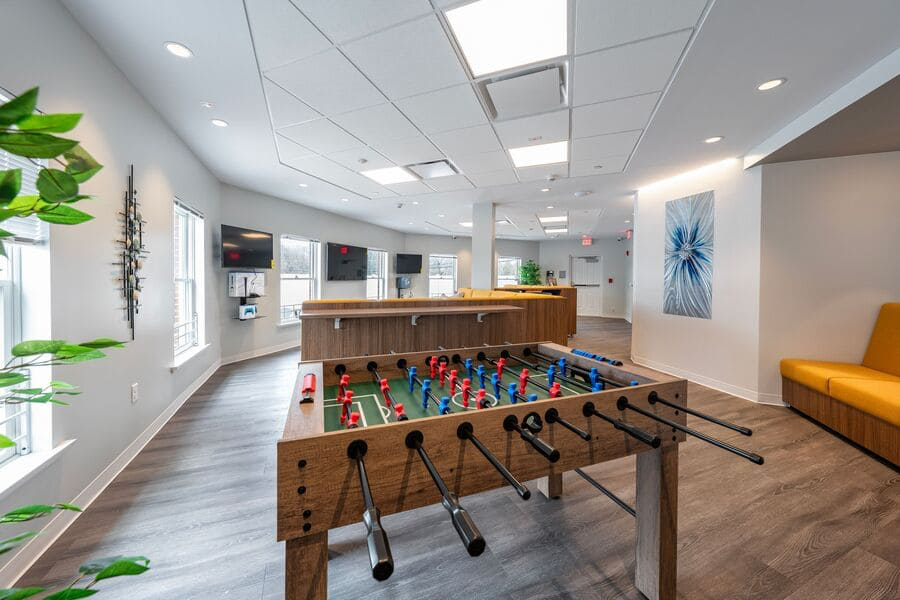
Photo: BlueCrest Detox
A bright common area at BlueCrest’s Detox facility, with a foosball table, plenty of seating, and wall-mounted TVs.
#2. Guardian Recovery, Princeton Addiction Center (Formerly Princeton Detox & Recovery Center) – Best for Detox Connected to a Full Continuum of Care in Middlesex County
Princeton Detox & Recovery Center operates as Guardian Recovery and is located in Monmouth Junction. It is part of a larger behavioral health network. Its website lists medically supervised detox along with residential care, partial hospitalization, and intensive outpatient programs.
Ask about: Which insurance plans are in network for detox specifically, and who leads the medical team.
Best for: Adults in Central New Jersey who want detox with other levels of care in the same organization.
#3. SOBA New Jersey – Best for Detox with Housing and Case Management in New Brunswick
SOBA New Jersey is a treatment provider in New Brunswick. Its website lists detox, residential, outpatient, and sober living housing programs.
Ask about: Which medications are used during detox and the accreditation status of the specific facility you would attend.
Best for: People in Central New Jersey who want detox and housing support in the same organization.
#4. Discovery Institute – Best for a Long-Established Provider with Detox and Residential Care in Marlboro
Discovery Institute is a drug and alcohol treatment provider in Marlboro, in Monmouth County. It says it has treated addiction since 1970. Its website describes medically supervised detox followed by residential care and intensive outpatient.
Ask about: Which medications are used during detox and whether a physician is on site around the clock.
Best for: Monmouth County residents who want detox and residential care from an established provider.
#5. Recovery Centers of America at Raritan Bay – Best for Detox with Defined Detox Timeframe in South Amboy
Recovery Centers of America at Raritan Bay is a large facility in South Amboy and is part of a national treatment network. Its website describes detox as typically lasting 5 to 10 days, followed by residential and outpatient levels of care.
Ask about: Who your physician will be and how individualized care is at a facility of this size.
Best for: People in Middlesex County who want a larger facility with a defined detox timeframe.
#6. Serenity at Summit – Best for Detox and Residential Care at One Site in Union
Serenity at Summit operates a facility in Union as part of a network with five locations across the East Coast. Its website lists medically supervised detox, residential care, and outpatient programs at the Union site.
Ask about: Which step-down levels, such as partial hospitalization or intensive outpatient, are available after residential care.
Best for: Families in Union County who want detox and residential care at one location.
Frequently Asked Questions
How Long Does Drug Detox Take?
It depends on the substance, how long and how heavily you used it, and your overall health. Providers in this guide describe ranges such as 3 to 7 days or a couple of days to a week or more, and the medical team decides when you are ready to move on. Ask the program how it decides that detox is complete and what happens next.
Is It Safe to Detox at Home?
Stopping some substances suddenly, especially alcohol and benzodiazepines, can cause serious medical complications, and opioid withdrawal can be severe even when it is not life-threatening. A medical evaluation should decide whether supervised detox is needed, so talk to a doctor or a detox program before you stop. If you have seizures, confusion, chest pain, or trouble breathing, call 911.
What Medications Are Used in Medical Detox?
Medications may be used to ease withdrawal symptoms and cravings, and the choice depends on the substance and your medical history. Some programs in this guide name specific medications, while others describe them only in general terms. Ask which medications the program uses, who prescribes them, and how you will be monitored.
Is Detox Enough to Treat Addiction?
No. Detox addresses physical dependence, but it does not address the reasons substance use started or the habits that sustain it. Most people do better when detox is followed by residential or outpatient treatment, therapy, and a plan for relapse prevention. Ask each program what it recommends after detox and whether that care is available in the same organization.
Should I Choose a Detox That Is Part of a Full Continuum of Care?
A detox that connects to residential care, partial hospitalization, or intensive outpatient can make the transition smoother, because your records, clinicians, and plan stay in one place. Some people prefer to detox in one program and continue treatment closer to home, which is also reasonable. The key is to have a confirmed next step before detox ends.
Does Insurance Cover Detox in New Jersey?
Many insurance plans cover medically necessary detox, but coverage depends on your plan and the level of care. Most programs offer free benefits verification. When you call, ask whether detox is covered, whether the program is in network for your plan, and whether prior authorization is required. Some programs in this guide do not accept Medicaid or Medicare, so confirm this early if you rely on public coverage.
Should I Prioritize Location When Choosing a Detox?
Detox is a short, intensive stay, so program fit and medical capability usually matter more than distance. Some programs offer transportation, which can help if you are traveling from another part of New Jersey or another state. The federal treatment locator at https://findtreatment.gov/ can help you search by location.
Should Family Members Be Involved in Choosing a Detox Program?
Often, yes. Family members can help with practical support, communication, and the transition after detox, and many programs include family therapy or educational sessions. Ask each program whether it offers family sessions, how families receive updates, and what the privacy rules are, since the person receiving treatment controls what is shared.
Conclusion: Matching the Right Detox to Your Situation
Choosing among these six New Jersey programs means matching medical needs, comfort, and location with the right level of support. BlueCrest Detox in Flemington suits people who want a private, quiet setting for medically supervised detox, with a direct path into continued care through BlueCrest Recovery Center’s PHP, IOP, and outpatient programs, with supportive housing available alongside treatment. The other programs on this list offer detox in Central and North New Jersey with varying levels of follow-up care.
Across all six, effective detox depends on medical evaluation, appropriate supervision, and a clear plan for what comes next. Before you admit anywhere, it helps to know how detox is supervised around the clock, which medications may be used, how long it typically lasts, who oversees medical care, and what treatment follows.
The BlueCrest Detox admissions team can answer all of these questions in one call. They can also explain what your first days will look like and how your care continues after detox. Call 908-379-0804 or visit https://bluecrestdetox.com/ to talk through your options confidentially.
If you are in crisis or worried about your safety, do not wait. Call 911 for a medical emergency or call or text 988 at any time to reach the 988 Suicide & Crisis Lifeline: https://988lifeline.org/.